
Overview
The eptos Classification Manager makes it possible to structure the entire range of objects (e.g. materials or products).
A sensibly divided classification hierarchy forms the basis for an efficient classification system and helps to group certain objects in a classification system.
The focus is not on the individual products, but on their groupings. The goal of classification management is to order the variety of objects for a better overall appearance.
/*<![CDATA[*/ div.rbtoc1770892093548 {padding: 0px;} div.rbtoc1770892093548 ul {list-style: disc;margin-left: 0px;} div.rbtoc1770892093548 li {margin-left: 0px;padding-left: 0px;} /*]]>*/ Overview Classification Classes and their Hierarchy
Classification Classes and their Hierarchy
The first step when attempting to formally describe or classify objects of the real world in a semantic model is to separate them into distinct categories.
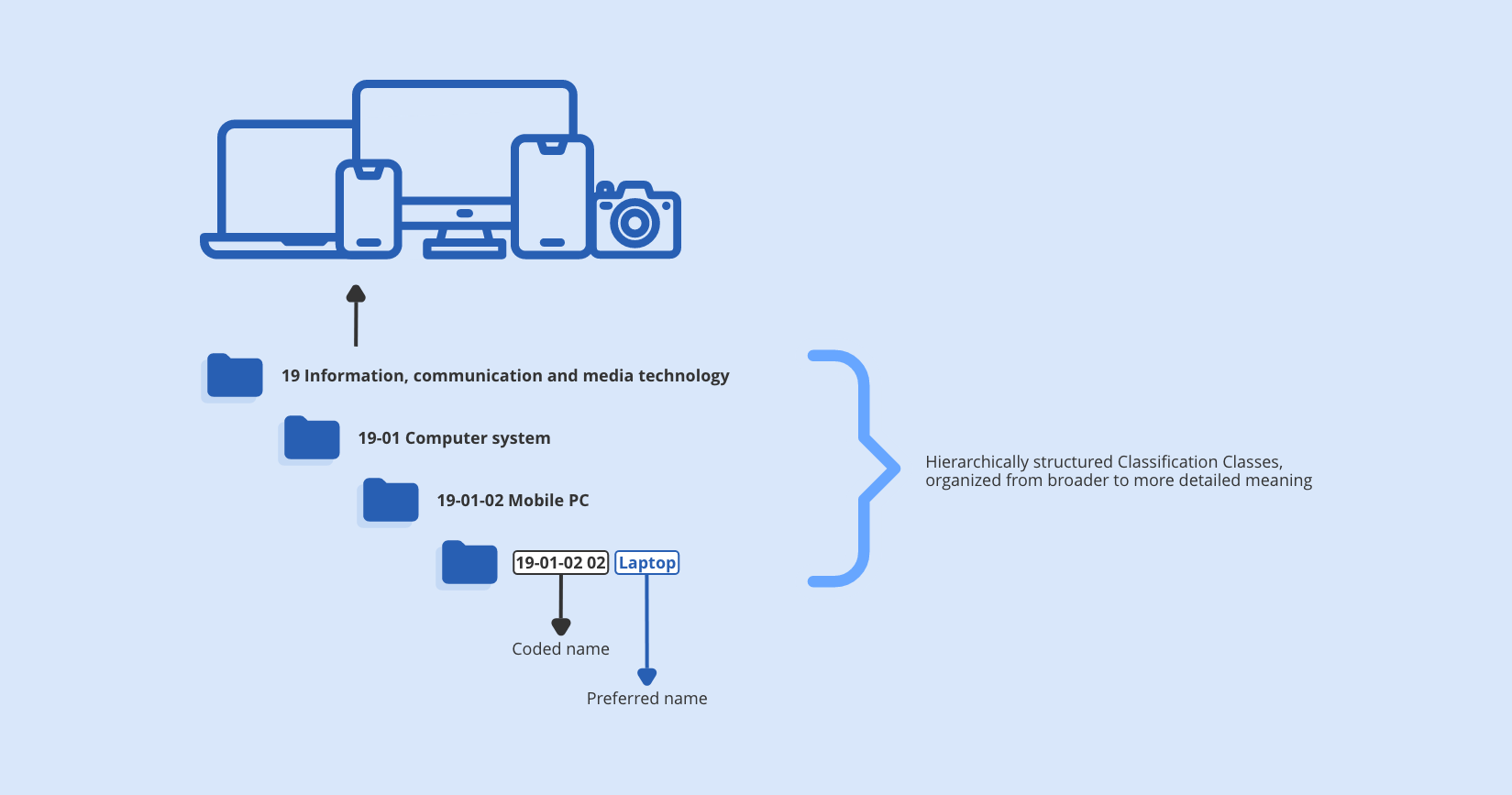
If we take a laptop as an example, before starting the actual description, one would first define broader categories in which a laptop would fit, such as Electronic devices with sub-category Computers and accessories, or Information, communication and media technology with sub-categories Computer system and Mobile PC.
These categories used to group representations of similar objects of the real world are referred to as Classification Classes. The Classification Class helps to categorize the described product(s) and divide them into certain categories of similar products.
Classification Classes are organized hierarchically, from a broader to a more detailed category. In addition to a main label (preferred name), the Classification Classes have a so called Coded Name, which is a unique, human readable class code in a classification hierarchy (can be formed out of numbers, such as 19, 19-01, 19-01-02 etc., letters A, AB, AC etc. or combinations of the two A1, B2 etc.)
The purpose of such groupings into categories is an easy retrieval of the needed information. When searching for a specific product, users would look for the logical category of respective product, i.e. they would look for laptops in categories such as Electronic devices or Information & communication technology and for bread in categories such as Food or Bakery products.
The focus of Classification Manager is not on the individual products, but on their groupings. After defining the categories for grouping the representations of products (materials or other objects), one can proceed with the creation of the semantic model for the actual description of these objects. To learn more about this, please see the Dictionary Manager Documentation.