
Overview
Quantities and Units of Measure Manager allows users with appropriate rights to create, edit or delete Units.
Users having only viewer rights are able to search for Units and view their contents.
When opening the Unit menu entry in Quantities and Units of Measure Manager, user sees all Units available in system, as well as all existing Change Requests for Units listed in a Tabular view.
Further details on the graphical user interface and the tabular view are on page Graphical User Interface and Basic Functions.
General Information
The workspace area for the management of Units offers users different functionalities described in brief in the following table as well as in more detail in the next chapters.
Toolbar in Tabular View
|
Option Icon |
Option Name |
Description |
|---|---|---|

|
Content language |
Displays available information on Unit in the selected language |

|
Free text insertion field |
Allows user to insert search string |

|
Execute search |
Starts search process after all search criteria were set |

|
Perspective view |
Perspectives allow user to organize Units according to arbitrary ordering criteria into libraries. For details on this view, please see chapter "Perspective view", page Graphical User Interface and Basic Functions. |

|
Export |
Allows organizing Unit DIN 4002 or UnitML1.0 export |

|
Create |
Allows the creation of a new Unit |

|
Change text |
Allows user to change editable attributes of selected Unit. Non-editable attributes are also displayed, but as read-only. |

|
Remove |
Allows user to delete or only deprecate selected Unit. |

|
Reactivate |
Allows user to reactivate the selected deprecated Unit. |

|
Equivalent |
Allows user to set equivalences between Units. |
View
This operation is performed via selecting in tabular view the ID link or the IRDI link of the desired Unit. This way user has the possibility to open an Unit in a view mode where all the Unit details are displayed.
Table with available tabs containing attributes with brief description:
|
Name |
Description |
|---|---|
|
General |
Tab General displays information on the standard and extended Attributes of the selected Unit. For instance: Code, Version, Revision, ID, Name, ECE code. The visibility and order of the attributes displayed in tab General is configurable by users with configuration rights via the Validation Framework. |
|
Admin |
Tab Admin displays administrative information such as creation date, version date and creator of selected Unit. |
|
Relations |
Tab Relation displays information on the relations of selected Unit to other Units (e.g. Unit mappings) |
|
Attribute |
Tab Attribute displays Extended Attributes of the selected Unit. |
|
Change request |
Tab Change request displays the Change Requests in connection with the selected Unit. |
|
History |
Tab History displays historical information on the selected Unit (e.g. when Unit was created, by whom) |
|
Release |
Tab Release displays the release(s) the Unit is part of. |
|
Reference |
Tab Reference displays in a tabular view information related to the Property(ies) in which the selected Unit is used. |
|
Equivalent units |
Tab Equivalent units displays information on any existing Equivalent Units from the same dictionary or from other dictionaries. |
|
Log |
Tab Log displays information on changes executed by users on the selected Unit (e.g. details on what was edited on Unit, by whom, timestamp, the change source). Logging information is visible only for users with administrator rights. |
Search
Quick Search
Unit tabular views of Quantities and Units of Measure Manager offers a "Search" functionality with multiple search criteria and options. The search can be triggered by selecting Search option and returns results for both lists: Unit on top and Unit related Change Requests below.
Advanced Search
The advanced search can be opened by selecting the Advanced Search arrow situated below the search field.
The available choices are described in below search sections:
In "Search In" user is allowed to select multiple search criteria from:
-
ID → Search in the identification (IRDI, SCV, Code)
-
Extended attribute search → Search in Extended Attributes
-
DIN notation → Search in DIN notation data
-
ECE code → Search in ECE code data
-
ECE name → Search in ECE name data
-
Name → Search in Name
-
Short name → Search in Short name
-
Commercial unit → Search in Commercial unit data
Section "Search options" also allows multi-selection from:
-
Match pattern from start → Search returns results that match the whole input from start
-
Pattern not contained → Search returns results that do not contain the string in the input
-
Show last version → Search returns results of only the last version of each Unit
Section "Restrict unit search to" allows user to choose between:
-
All fields → searches in all fields (set as default due to frequent use)
-
Selected fields → searches only in selected fields
In section "Additional criteria" user has the possibility to select (multi-selection is allowed) needed:
-
Dictionar(ies) → search in Units of selected Dictionar(ies)
-
Release(s) → search in Units of selected Release(s)
Advanced search options may be combined.
Change Request Search
Unit tabular view displays Change Request lists with separate Search function offering following criteria:
-
Text → Search in the Preferred Name
-
ID → Search in the identification (ID)
-
Match pattern from start → Matches the input string from start
Search is executed by means of Search option in Change Request list.
Both Structure Elements and Change Requests lists will be updated and displayed.
Export
Users with appropriate rights have the possibility to organize Unit exports.
The following export formats are available:
→ from the tabular view of Units:
-
DIN 4002
After defining the export options in the graphical user interface, the user may start export by selecting Export option. Export will be started in the background, system informs user via a console message and the exported file will be sent per e-mail to the specified e-mail address.
Export Options DIN4002 Export Format
Through a redesign of the eptos export pages, the external appearance of the exports has now been fully adapted to the defined Usability Guidelines.
This has significantly improved the look and feel of these pages.
In a harmonized DIN 4002 Export dialog the user can save and load favorite dialog settings in tab “Selection of attributes” to access those settings faster instead of selecting them again for each new export.
|
Tab |
Option |
Description |
|---|---|---|
|
General |
Export range |
The Export range option offers the following selection possibilities:
|
|
General |
Split file into chunks |
Allows user to decide via check-box whether the file should be exported in one complete file or separated in more, smaller files. |
|
General |
Table result renderer |
Allows users to select the export format:
|
|
General |
Export languages |
Contains list of all available content languages, including check-box for selection. As soon as box is checked, respective language is added in the Export languages field, including option for removal. |
|
General |
To: * |
Allows users to input the e-mail address where the exported file will be sent. |
|
General |
CC: |
Allows users to input the e-mail address where a carbon copy of the exported file will be sent. |
|
Selection of attributes |
Export attributes |
Allows users to select from a set of predefined Unit Attributes the ones which will be included in the export by selecting the needed columns which are displayed by column name and column code. user also has the possibility to select the export languages. Note: Attribute IEC Classification, which is optional and not language specific, may also be included in Unit XLSX export. |
Create
The workspace area for the creation of Units can be accessed via toolbar option Create. System opens create Unit dialog. This workspace offers users the possibility to define values for all the needed attributes.
Units can be created by users assigned to at least Unit Manager Editor role.
Mandatory attributes are marked with an asterisk. Non-editable attributes are displayed as read-only. Translatable fields are marked with a country flag.
Note: Attributes DIN Notation and Source are no longer mandatory.
User has the possibility to add attribute IEC Classification which is the Classification of Unit according to IEC.
Below are the formulas to calculate a value between a specific Unit and the primary Unit:
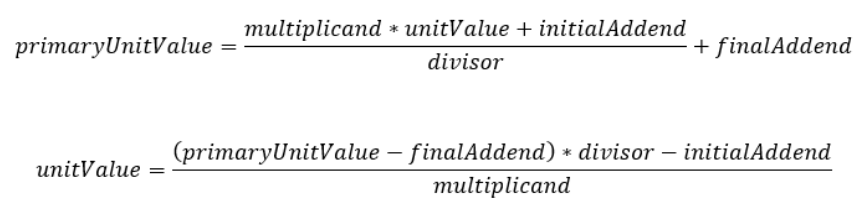
All these constants (initial addend, final addend, multiplicand, divisor) are part of the Unit and represent constants relative to the primary Unit.
A Quantity can be expressed by different Units. For example:
-
Time (duration) can be expressed in following Units: seconds or minutes or hours or other Units
-
Length can be expressed in millimeters, centimeters, meters, kilometers but also in feet or inches or other Units
-
Mass can be expressed in grams, kilograms, but also in pounds or ounces or other Units
-
Temperature can be expressed in degrees Celsius or degrees Fahrenheit or Kelvin
The value will change depending on the used Unit, but the actual physical Quantity being described must remain the same. The process of changing between these different Units is called Unit conversion.
In order to achieve that, a conversion factor is needed. Between second, minute and hour, the conversion factor is 60 and it is multiplied (multiplied by 60 - most commonly used). Between centimeters and millimeters the conversion factor is 10 and it is divided (divided by 10). Between degrees Celsius or degrees Fahrenheit the conversion factor is 32, it is fix and it is added (32 will be added).
The commonly used conversion factor was split up in 4 fields to better reflect what operation needs to be done: multiplication, division or addition. For these conversions the system offers user following fields in Unit / tab General:
-
Initial addend
-
Final addend
-
Multiplicand
-
Divisor
For an image with the Create dialog, please see chapter "Create view" on page Graphical User Interface and Basic Functions.
When the work is finished, the user may save the new Unit as Change Request via Save option or directly as Structure Element via Save and Release option.
Change Requests usually undergo an approval process before they are released and become effective.
Change text
In order for user to edit the textual attributes of an Unit, first the desired object needs to be selected by check-box from the tabular view, then option Change text needs to be selected. System opens edit Unit interface.
Here user may change the value of every needed Unit attribute.
In order that performed changes to be applied, user needs to store changes by selecting Save or Save and Release option.
For more information, please see above chapter Create.
Remove
The toolbar in tabular view provides user also with Remove option. This functionality allows users to deprecate or delete existing Units.
Units may be deleted by users assigned to one of the following roles: Unit Manager Editor and Unit Manager Administrator.
In order for user to delete an Unit, first the desired object needs to be selected by check-box from the tabular view, then option Remove needs to be selected. User is redirected in remove dialog where system displays the details page of the Unit selected for deletion. User may check the attributes/relations of the Unit before proceeding with the deletion.
A reason for removing the selected Unit is also required.
Here user has the possibility to decide if the removal should be organized as a deletion or as a deprecation by ticking or leaving check-box "Is deprecation" unticked. If removal is set as deprecation, Unit will be marked as deprecated, meaning that it is withdrawn from further usage. Deprecated elements are displayed grayed out in the system and they cannot be worked on or used anymore.
Note: Under the tab “Reference”, all instances where the selected Unit is used are displayed, so that the user can evaluate the impact the operation will have on the entire content.
After all settings were performed, user has two possibilities to start the process:
-
Save → Creates a Change Request for the Unit removal (Change Requests usually undergo an approval process before they are released and become effective)
-
Save and release → Change Request for Unit deletion will be automatically executed (released). As a result, the Unit is immediately withdrawn from further usage and is displayed as inactive within a given release (grayed out)
After process is completed, user is informed of the outcome via a console message that process was successful.
Reactivate
This functionality allows users to reactivate (i.e. to make them available for usage within a certain release) a deprecated Unit.
The Reactivate options is active only if the selected Unit meets the condition of being deprecated.
In order to reactivate a deprecated Unit, user needs to select desired deprecated Unit in the tabular view and select Reactivate option.
Note: In order for user to see a deprecated element, relevant setting under user profile / Dictionary Manager section needs to be configured accordingly.
After deprecated element and Reactivate option were selected, system displays the Reactivate graphical user interface, which consists of the detailed view of the selected Unit. Therefore, user can first check the detailed information of selected Unit before starting the reactivation. A reason is also required.
Note: By ticking check-box in field “Reactivate unit usages” system will allow reactivation of selected Unit in all elements where it was used before deprecation.
Process may be started by selecting one of the following options:
-
Save → Creates a Change Request for the Unit reactivation (Change Requests usually undergo an approval process before they are released and become effective)
-
Save and release → Change Request for Unit reactivation will be automatically executed (released). As a result, the Unit is immediately activated and can be used
After process is completed, user is informed of the outcome via a console message that process was successful.
Equivalent
The toolbar in tabular view provides user also with Equivalent option. This functionality allows users to create equivalences between existing Units.
In order to have access to this functionality, user needs at least Unit Mapping Editor role.
Select two desired Units between which the equivalence needs to be created and select Equivalent option in order to finalize the process.
System displays message: "Equivalency is performed!" or "Equivalency already exists!" in case this equivalency was already created.
If an Unit that has an Equivalence is opened in detail view, all equivalent Units are displayed with attributes in tab "Equivalent units". From here user may also remove not needed equivalencies from Delete option in column "Actions".